Beard Growing Stages: What to Expect Each Month
The GrowerI'm writing this from the tailgate of my truck at the edge of the garlic field. It's the third week of October here in Boron, the ground's still soft, and I've just pressed the last row of cloves into the dirt. They won't be ready to pull until next summer. Every fall some young Adventurer looks at the bare rows and asks when something's going to happen. Same question they ask about their chins.
So here's the short answer on beard growing stages. Beard hair grows roughly 1/3 to 1/2 inch a month for most men. Expect stubble in week 1, a scratchy, itchy short beard by week 4, something that looks like an actual beard around months 2 to 3, and real length you can shape between months 3 and 6. Genetics set the pace and thickness, and nothing in a bottle changes that. You control how comfortable your skin feels and how good the beard looks while you wait.
- Most beard hair grows about 0.3 to 0.5 mm a day, which works out to roughly 1/3 to 1/2 inch a month. Some men grow faster, and plenty grow slower.
- Week 1 is stubble, weeks 2 to 4 bring the itch, months 2 to 3 hold the awkward stretch, and months 3 to 6 are when real shape and length show up.
- Judge your beard at about 3 months, not 3 weeks. Gaps often look smaller once the hair around them gets longer.
- Start beard oil around week 2 for the skin, add a balm or butter once there's hair to hold, and stick to small tidy-up trims instead of big cuts.
How fast does a beard actually grow?
A 2016 review of beard hair in the International Journal of Cosmetic Science (Maurer and colleagues) puts it at about 0.3 to 0.5 mm every 24 hours. Healthline's write-up of that research translates it to roughly a third to a half inch a month (Healthline: How to grow a beard). That's an average, and it isn't even across your face. Chins and mustaches often run ahead of the cheeks.
Two things decide how your field comes in: genetics and age. How your follicles respond to hormones is largely inherited, which is why a look at your dad, uncles and grandfathers tells you more than any label will. Cleveland Clinic explains why some men simply grow less. Many men keep filling in through their twenties, so a thin crop at 22 isn't the final harvest.
Beard growing stages at a glance
Here's my almanac, the beard growth timeline I'd hand any young grower. Lengths assume an average grower who hasn't trimmed, so treat them as rough ranges rather than targets.
| Stage | Typical length | What you'll notice | What to do |
|---|---|---|---|
| Week 1 | About 1/8 inch (2 to 3 mm) | Stubble, a darker shadow, rough on the pillowcase | Stop shaving and leave it alone, neck included |
| Weeks 2 to 4 | About 1/8 to 1/2 inch | Itch, tight or flaky skin, hairs pointing every which way, your first look at gaps | Start beard oil daily, use a gentle wash, don't judge the patches yet |
| Months 1 to 2 | About 1/3 to 1 inch | Itch fades for most men. Shape is lumpy, cheeks lag behind the chin | Oil and comb daily, tidy the neckline and cheek line only |
| Months 2 to 3 | About 3/4 to 1 3/4 inches | The awkward stage: puffy sides, curls, stray hairs, the urge to shave | Add balm or butter, one light shaping trim if you need it |
| Months 3 to 6 | About 1 to 3 1/2 inches | A beard that looks like a choice. Small gaps start to cover. Ends can get dry | Balm for daytime hold, wash and condition, shaping trim every 4 to 6 weeks |
| 6+ months | 3 inches and up | Weight pulls the hair down, split ends show up, length varies by area | Full routine with butter at night, trim the ends lightly to keep it even |
Week 1: Planting
The first week mostly happens below the soil. By day 3 or 4 you'll see a darker shadow, and it'll feel like sandpaper. There's not much to do except stop shaving. Let the neck go too, so you can see where your natural neckline wants to sit.
Weeks 2 to 4: Mud season and the itch
The short hairs have sharp, freshly cut tips that poke back at the skin. Most men get itchy somewhere in here, often around week 2.
This is when I'd start beard oil. Not to grow anything, just to keep the skin underneath from going tight and dry. Three or four drops after a shower, worked down to the skin before you pull it through the hair. Trying an oil for the first time? Put a drop on your jaw and wait a day, and stop if your skin turns red. Our beard itch guide has the full rundown, including when an itch is worth a dermatologist visit.
Months 1 to 2: First green rows
By the end of the first month most men have a short beard, somewhere around a third to a half inch. The itch usually backs off. The shape is lumpy, with cheeks thinner than the chin and the neck trying to take over.
Weed the edges and leave the crop alone. Clean up the neckline about a finger or two above your Adam's apple, plus the stray hairs high on your cheeks. The Marksman walks through it cut by cut in how to trim your beard while growing it out.
Months 2 to 3: The awkward stage
Every crop looks worse before it looks better. The sides puff out, some hairs curl while others grow straight, and you'll catch yourself in a shop window and think about the razor.
The Troll keeps the bridge at the edge of my land, and he's written the field guide to this stretch: the beard awkward stage and how to get through it. The short version from me is to add a balm or butter now, since it gives you something to press those puffy sides down with, and get one gentle shaping trim if the mess is wearing on you.
Months 3 to 6: The harvest starts
Somewhere around month 3 you'll have a beard that looks like a decision. At an average pace that's 1 to 2 inches, and by month 6 it's closer to 2 to 3 1/2. Curls hide length, so trust the ruler over the mirror.
This is the right time to judge your patches. Longer hair from around a gap often lies right over it. If one area still hasn't come in, that tells you something useful about your growth pattern, and a style that suits it will do more than another month of hoping. Start with our beard styles guide. If you're wondering whether oil can fill the gaps, it can't create new follicles, but here's what beard oil can do for a patchy beard.
6 months and beyond: Long seasons
Past 6 months you're into long-beard country. Weight helps the hair lie flat but shows off split ends and dry tips. The skin underneath still matters here. A long beard pulls oil away from your face, so dry skin can come back every winter even on a beard you've worn for years.
That's the last of the beard growing stages. From here it's upkeep: trim the ends lightly every 6 to 8 weeks and use butter at night when the air turns dry.
How long does it take to grow a beard? It depends on the goal
Here's rough timing by the look you're after, assuming average growth:
- Heavy stubble: 1 to 2 weeks.
- A short, boxed beard: about 1 to 2 months.
- A full, medium beard you can shape: about 3 to 4 months.
- A long beard of 4 inches or more: roughly 8 months to a year, depending on how much you trim along the way.
Sleep, decent food, not smoking and not quitting in month 2 matter more than any product. Our guide on how to grow a beard faster sorts the myths from the useful stuff.
What I keep in the barn
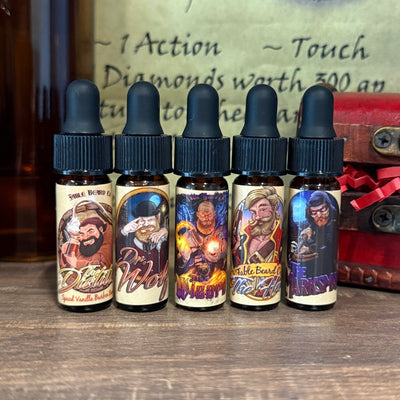
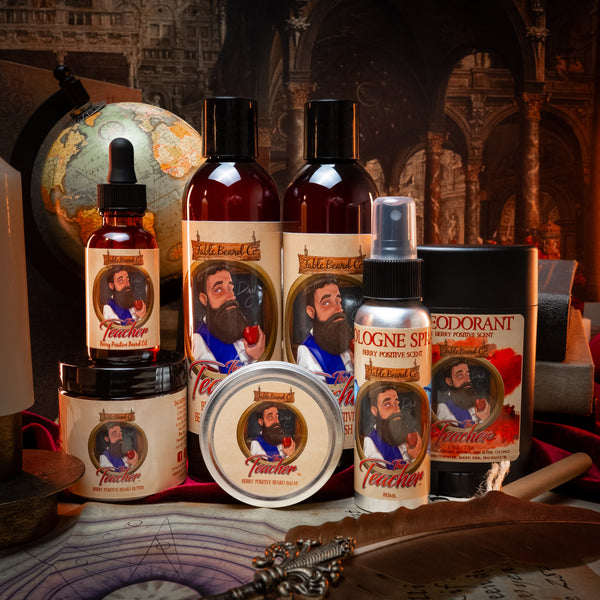
The Grower beard oil is my own blend: crisp apples, fresh pear, warm oud and aged amber. It's built on five carrier oils, including argan, jojoba and castor, and comes in a 1 oz bottle for $18.99. If you're curious why argan turns up in so many blends, The Djinn wrote about argan oil for beards.
Once there's hair to hold, around month 2, add The Grower beard balm (2 oz tin, $23.99) for daytime hold. If you'd rather have softness than hold, The Grower beard butter (4 oz, $26.99) is shea and cocoa butter with a touch of beeswax, and it's my night pick once the first frost comes.
If you wear cologne or your skin doesn't care for fragrance, The Barkeep is unscented and the same size and price. More in his post on unscented beard oil, and the rest of the lineup lives in our beard oil collection.
FAQ
What are the stages of beard growth?
Roughly: stubble in week 1, an itchy short beard in weeks 2 to 4, a lumpy short beard in months 1 to 2, the awkward stage in months 2 to 3, and a full beard you can shape from months 3 to 6. After 6 months you're mostly growing length.
How long does it take to grow a full beard?
For most men, about 2 to 4 months to look full and 3 to 6 months to have enough length to shape. Genetics and age set the pace, and some men keep filling in through their twenties and into their thirties.
How much does a beard grow in a month?
Usually about a third to a half inch. That comes from a daily rate of roughly 0.3 to 0.5 mm, and it varies from man to man and between the cheeks, chin and mustache.
When does beard itch stop?
For most men it eases somewhere between weeks 3 and 6, once the hairs are long enough to lie flat instead of poking at the skin. Beard oil and a gentle wash help keep the skin comfortable in the meantime. If redness or a rash hangs on, see a dermatologist.
Should I trim my beard while growing it out?
Yes, but only the edges at first. Keep the neckline and the stray hairs on your upper cheeks tidy from month 1, and save shaping trims for month 2 or 3, taking off a little at a time.
One last thing
The garlic I planted this morning will sit under straw all winter looking like nothing at all. Come spring, green shoots will push up in neat rows, and by July I'll be pulling heads the size of a fist. Your beard runs on the same kind of calendar. Plant it, tend it and give it a full season before you judge the crop.
Your beard, your story.
— The Grower